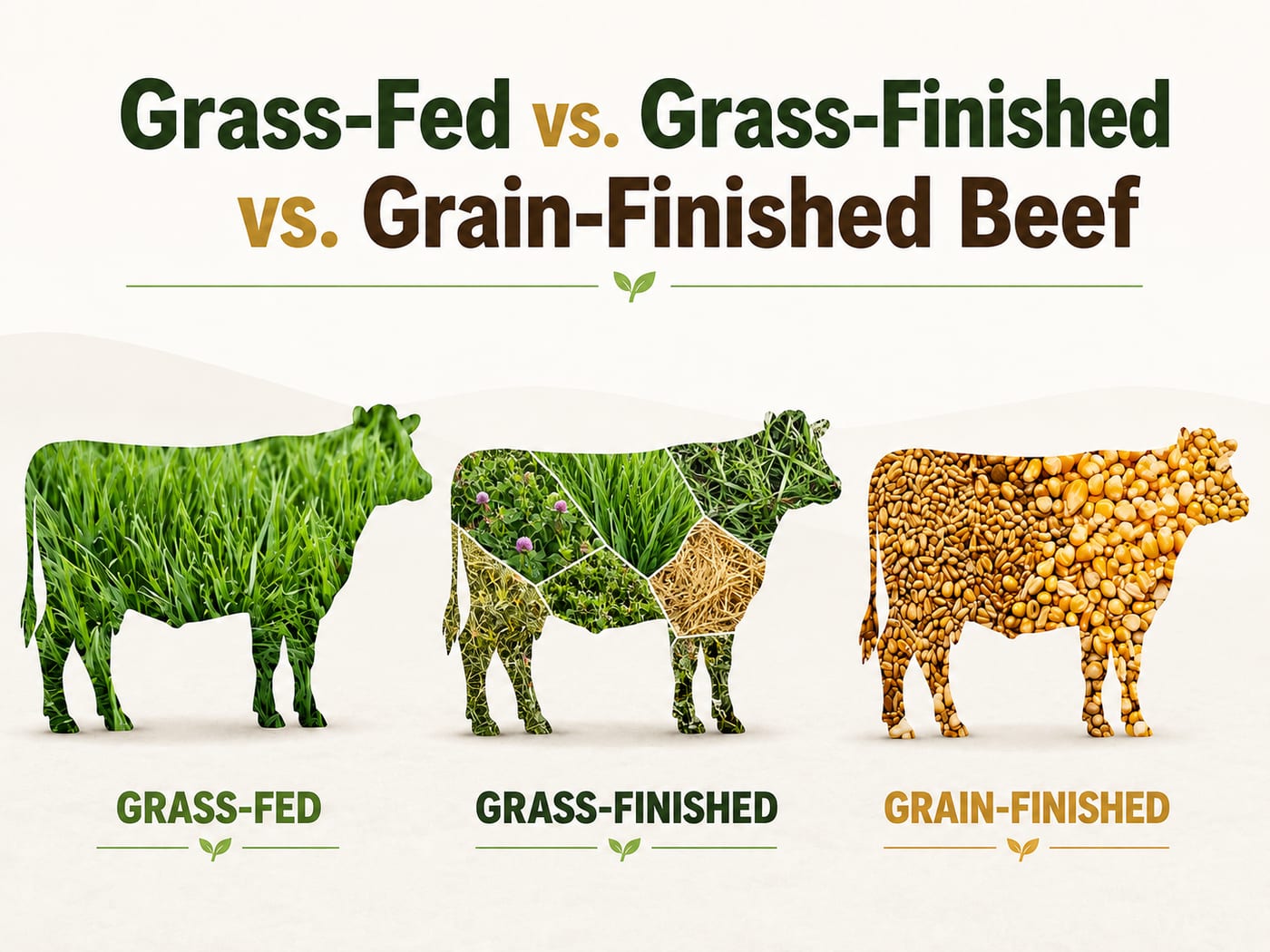
<p><strong>TL;DR:</strong> Almost every beef animal in the country starts life on grass. What sets the labels apart is how the animal is <em>finished</em>, meaning what it eats in its last few months. "Grass-finished" means forage all the way to the end. "Grain-finished" means a grain ration at the end. "Pasture-raised" describes where the animal lives, not what it eats. And a plain "grass-fed" claim no longer has a federal standard behind it. Spring Lake cattle are pasture-raised from spring through fall and finished over winter in our own pens on a mix of grain and home-raised forages.</p><p>If you have ever stood in front of a meat case trying to decode the words on the label, you are not imagining the confusion. Grass-fed, grass-finished, grain-finished, pasture-raised, all-natural: it all gets stamped on packaging, and most of it gets used loosely. This is the page we point people to when they ask us, at the fence or on the phone, what the difference really is and which one we are.</p><p>Here is the whole thing, plainly.</p><h2>Almost every cow starts on grass</h2><p>Start with the one fact that unlocks the rest. Nearly every beef animal raised in the United States spends the first and largest part of its life the same way: out on pasture, nursing and then grazing alongside its mother. Calves are born on grass. They stay on grass through weaning. For most of the animal's life, grass and forage are the whole diet. That part is nearly universal, whether the beef ends up in a supermarket cooler or in your freezer from a ranch like ours.</p><p>The differences everyone argues about happen at the <em>end</em>, during what ranchers call finishing. Finishing is the last stretch before harvest, usually a few months, when the animal is brought up to its final weight and condition. What the animal eats during that window is what the labels are really describing. So the honest question is not "grass or grain." It is "grass-finished or grain-finished." Almost everything before that point is shared.</p><h2>What each label actually means</h2><p><strong>Grass-finished.</strong> The animal eats grass and forage its entire life, including that final finishing window. No grain at the end. Because forage carries less energy than grain, grass-finished animals take longer to reach weight and tend to finish leaner. This is the most demanding way to raise beef, and when done well, it produces a bold, slightly mineral flavor.</p><p><strong>Grain-finished.</strong> The animal is <a href="https://extension.psu.edu/grass-fed-vs-grain-fed-beef" rel="noopener noreferrer" target="_blank">raised on pasture and then moved onto a grain ration</a> for its final months. Grain is higher in energy, so the animal gains more efficiently, and the meat usually picks up a little more moisture and marbling. The large majority of beef sold in this country is grain-finished. One thing worth saying loudly: grain-finished does not have to mean a giant commercial feedlot. A ranch can finish its own animals in its own pens, with its own family doing the work, on a mix of grain and home-raised forage. That is exactly what we do.</p><p><strong>Pasture-raised.</strong> This term describes living conditions, not diet. It means the animal lived out on open pasture rather than in confinement. An animal can be pasture-raised and still be grain-finished, because the two words answer different questions: where it lived, versus what it ate at the end.</p><p><strong>Grass-fed.</strong> This is the slippery one. People hear "grass-fed" and picture an animal that never touched a kernel of grain. But the term has been used loosely for years, and here is the part most shoppers do not know: in January 2016, the USDA's Agricultural Marketing Service <a href="https://www.usda.gov/about-usda/news/blog/understanding-ams-withdrawal-two-voluntary-marketing-claim-standards" rel="noopener noreferrer" target="_blank">withdrew its official grass-fed marketing standard</a>, having concluded it did not have the authority to define the claim. Since then, there has been no single federal definition sitting behind a plain "grass-fed" label.</p><p>While you are decoding labels, treat words like "natural" the same way. "Natural" is close to meaningless on a meat package, and "no added hormones" is already true of a great deal of beef. The words that actually tell you something are the ones about finishing, and even those are only as trustworthy as the person standing behind them.</p><h2>Why "grass-fed" on a package means less than you think</h2><p>When the USDA pulled that standard, it did not ban the term. It just stopped defining it. Producers can still make a grass-fed claim, but they have to back it up through a third-party certifier or their own documented standard, and not every operation does. The practical result is that two packages both reading "grass-fed" can mean genuinely different things, and the label alone will not tell you which.</p><p>This is the real argument for buying ranch-direct. You do not have to decode a label, because you can ask the person who raised the animal. What did they eat? Where were they finished? Any rancher worth buying from will answer in plain language. That back-and-forth is the whole reason this <a href="https://springlakecattle.com/field-guide" rel="noopener noreferrer" target="_blank">Field Guide</a> exists, and it is something a barcode can never give you.</p><h2>Does the nutrition difference actually matter?</h2><p>You will read that grass-finished beef is dramatically healthier. The truth is more measured. Grass-finished beef does tend to carry <a href="https://livingwell.tamu.edu/grain-fed-vs-grass-fed/" rel="noopener noreferrer" target="_blank">somewhat more omega-3 fatty acids, roughly twice as much</a>, along with more conjugated linoleic acid (CLA). That much is real. But the absolute amounts are small. That "twice as much" omega-3 works out to only about thirty milligrams more per serving, and beef is not a meaningful omega-3 source either way.</p><p>Both grass-finished and grain-finished beef are nutritious. Both deliver high-quality protein, iron, zinc, and B12. If you are choosing a protein mainly for omega-3s, fish is the choice, not beef. We would rather tell you that straight than sell you a few milligrams dressed up as a miracle.</p><h2>Where Spring Lake fits</h2><p>Here is exactly what we do, with no softening.</p><p>Our cattle are out on open Magic Valley pasture through spring, summer, and fall. When winter closes in, they come into our own pens here on the ranch, where they are <a href="https://springlakecattle.com/our-practices" rel="noopener noreferrer" target="_blank">finished on a diet of both grain and our own home-raised forages</a>. No commercial feedlot. No anonymous middleman. The same family that raised the calf finishes the animal and hands you the beef.</p><p>What we will not do is dress that up as something it is not. Our beef is not grass-finished, even though that label tends to fetch a premium, and we are not going to call it that. We would rather be straight with you, and that honesty is the point. And if you ever want to walk the pasture or see the pens for yourself, come out. We do not run a closed shop, and we are happy to show you.</p><h2>The Piedmontese wrinkle most ranches cannot claim</h2><p>Here is where our breed changes the whole equation.</p><p>Most of the grass-finished sales pitch rests on a single idea: grass-finished beef is leaner. For a conventional Angus, that is largely true, because grain-finishing is precisely how you build the fat and marbling. But Spring Lake raises <a href="https://springlakecattle.com/breed" rel="noopener noreferrer" target="_blank">Piedmontese</a>, and Piedmontese carry a natural change in the myostatin gene that makes them "double-muscled," producing far more lean muscle and far less fat than a typical breed. USDA researchers describe the result of that gene as <a href="https://agresearchmag.ars.usda.gov/1999/jun/beef" rel="noopener noreferrer" target="_blank">superbly lean but still tender</a>.</p><p>In other words, our cattle are lean because of their genetics, not because of their diet. Finishing a Piedmontese on grain and forage does not turn it into a fatty animal. It simply adds a touch of moisture and flavor to an animal that was always going to be lean. So you get the leanness people chase when they seek out grass-finished beef, plus a little of the richness and the more forgiving texture that a grain-and-forage finish brings. On a Piedmontese, you do not have to choose between the two.</p><h2>So which should you buy?</h2><p>If your priority is the leanest, most forage-driven beef and a stronger, more mineral flavor, true grass-finished beef is worth seeking out. Just buy it from someone who can actually prove the claim. If you want lean beef that still cooks up tender, with a little more moisture and a more forgiving margin for error, a Piedmontese finished on grain and forage, like ours, is hard to beat.</p><p>Whatever you choose, remember that lean beef of any kind cooks faster and dries out quicker than the fatty beef most people are used to from the supermarket. Cook it a little gentler, use a thermometer, and pull it before you think it is done. The reward is a leaner, cleaner-tasting steak that is still tender.</p><p>And if you want beef from people who will tell you exactly how the animal was raised, finished, and cut, with nothing hidden behind a label, that is us.</p><h2>Frequently asked questions</h2><p><strong>Is grass-fed the same as grass-finished?</strong> No. "Grass-fed" gets used loosely and has had no federal standard behind it since 2016. "Grass-finished" specifically means the animal ate only grass and forage through its final months, with no grain at the end.</p><p><strong>Is grain-finished beef unhealthy?</strong> No. Grain-finished beef is nutritious and high in protein, iron, zinc, and B12. Grass-finished beef carries somewhat more omega-3s and CLA, but the difference per serving is small.</p><p><strong>Does grain-finished mean feedlot beef?</strong> Not necessarily. A grain finish just means grain in the ration at the end, usually alongside forage. It can happen in a large commercial feedlot, or in a family's own pens, the way it does here. The right move is to ask the producer where and how.</p><p><strong>Is Spring Lake beef grass-fed?</strong> Our cattle are pasture-raised on grass from spring through fall and finished in our own pens over winter on a diet of both grain and home-raised forages. We do not call our beef grass-finished, because it isn't.</p><p><strong>If Spring Lake finishes on grain, why is the beef still lean?</strong> Because the leanness comes from the breed's genetics, not its diet. The Piedmontese myostatin trait produces naturally lean, tender muscle, so finishing on grain and forage adds flavor and moisture without making the beef fatty.</p><p><strong>How should I cook lean beef so it doesn't dry out?</strong> Use lower heat and shorter cooking times, and pull the beef about ten degrees before your target temperature, then let it rest. A meat thermometer is the single most useful tool for lean cuts.</p><h2>Ready to taste the difference?</h2><p>We raise it, finish it, and hand it to you ourselves, so you always know exactly what you are getting. <a href="https://springlakecattle.com/cuts" rel="noopener noreferrer" target="_blank">Browse the cuts</a> or <a href="https://springlakecattle.com/newsletter" rel="noopener noreferrer" target="_blank">get on the newsletter</a>, and we will send a note when new cuts land and when the next Field Guide goes up.</p>
Get more like this in your inbox